UTMdev

Small Punch Test · EN 10371, Annex E

Small punch transition temperature

Do the tensile and fracture test at different temperatures, down to the temperature of liquid nitrogen. The energy decreases from the upper shelf to the lower shelf. The temperature at mid-height of the fit is the small punch transition temperature TSP.

  • 01Energy. ESP up to um, normalised by Fm.
  • 02Fit. A tanh curve through a minimum of 12 points.
  • 03Link to Charpy. TSP = α · TCVN, with absolute temperatures.
12
minimum number of test pieces (E.2)
3
minimum number in the upper shelf
α ≈ 0.42
standard geometry; 0.38 miniature (E.1)
−193 °C
lowest test temperature on the TTS 190
Ask for a test Ask a technical question

EN 10371, Annex E

From energy to transition temperature

Do the tensile and fracture test at different temperatures. The normalised energy changes from the upper shelf to the lower shelf. The temperature at mid-height of the fit is TSP.

Tests at different temperatures

The transition curve

The curve is schematic, with example values. EN 10371, Figure E.1, shows a measured example.
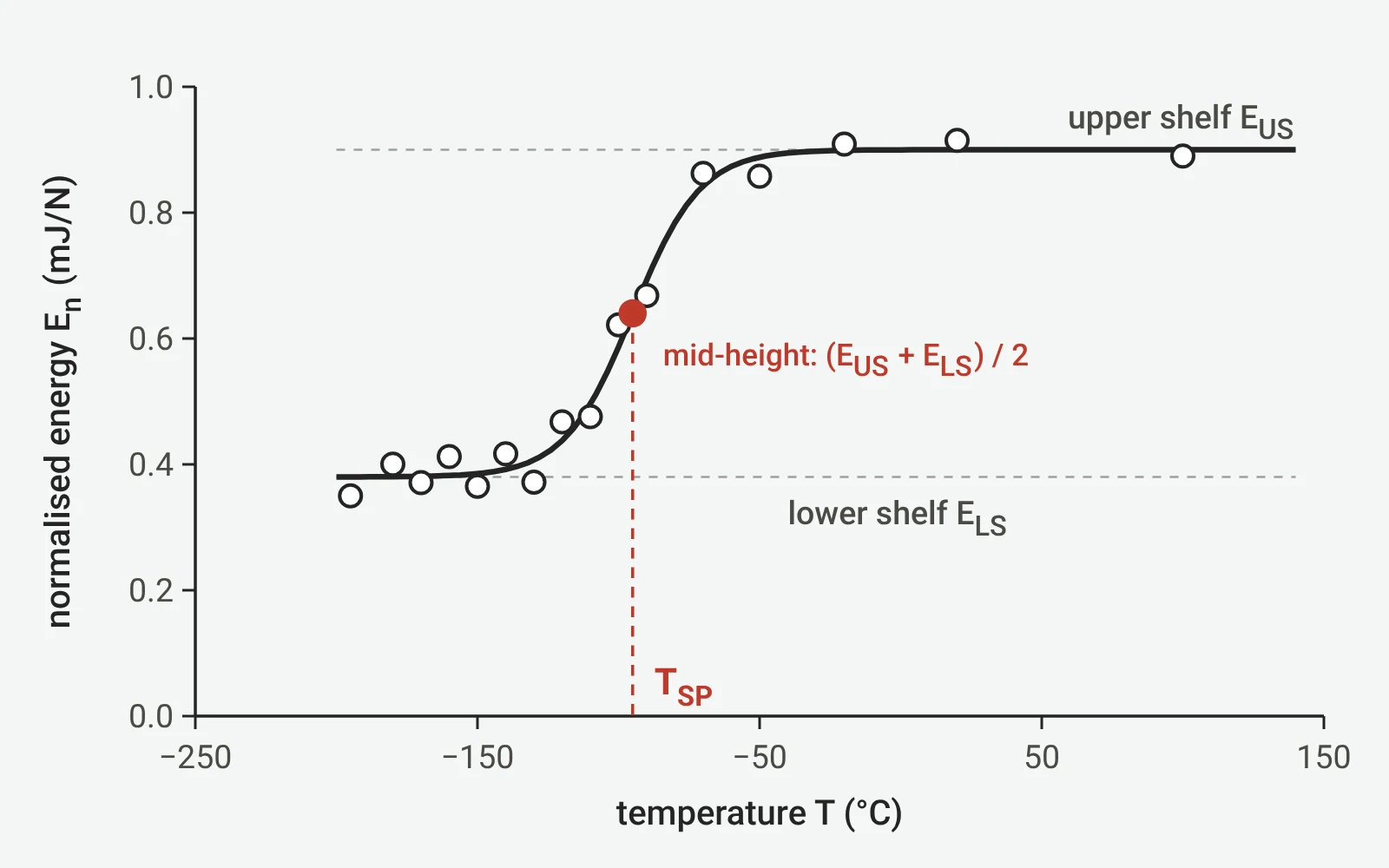
Schematic small punch transition curve: normalised small punch energy against temperature, tanh fit between the lower shelf energy and the upper shelf energy, small punch transition temperature T_SP at mid-height
  • Normalised small punch energyEn = ESP / FmPlot En against temperature. Fit the tanh curve of Formula E.4. Use a minimum of 12 test pieces.
  • Small punch transition temperatureTSPThe temperature at mid-height between the upper shelf and the lower shelf.
  • Link to CharpyTSP = α · TCVN (in K)EN 10371 (Formula E.1) gives α ≈ 0.42 for the standard geometry and α ≈ 0.38 for the miniature geometry.

TSP is lower than the Charpy transition temperature. It is a different value. The Small Punch Test gives a Charpy value only through correlation.

EN 10371, E.2

How to find TSP

  1. 1Do a minimum of 12 tests at different temperatures. Do a minimum of 3 of them in the upper shelf.
  2. 2For each test, calculate the small punch energy ESP up to um (Formula E.2).
  3. 3Divide ESP by Fm. This gives the normalised energy En (Formula E.3).
  4. 4Fit En(T) = A + B · tanh((T − TSP) / C) with a least-squares procedure (Formulae E.4, E.5).
  5. 5Read TSP: the temperature at mid-height, (EUS + ELS) / 2.
  6. 6If necessary, estimate the Charpy transition temperature: TCVN = TSP / α, with absolute temperatures (Formula E.1).

No deflection data?

Use F(v) in place of F(u). The energy values change, but the transition temperature does not change significantly (Annex E, note).

Alternative: fracture strain (E.3)

Fit the effective fracture strain εf = ln(h0 / hf) against temperature with the same tanh function.

α (E.1)

α ≈ 0.42 for the standard geometry and α ≈ 0.38 for the miniature geometry.

Cryogenic tests (6.2.2)

Make sure that ice does not affect the deflection measurement and the force.

Component in service?

Sampling and tests as a service

Sampling: we take a scoop sample on site from a cold component. Tests: send us your material. We do the Small Punch tests and send you a test report to EN 10371.

Ask for a test How we take the sample

Method pages

Other parts of the method

OverviewThe Small Punch TestPrinciple, the tests, comparison with conventional tests, history and FAQ.to the overview →Small Punch | CreepSmall Punch Creep TestEN 10371, clause 8 · Annex GConstant force at high temperature: creep curve, minimum deflection rate, time to rupture, equivalent stress.to the creep test →Small Punch | Tensile and fractureSmall Punch tensile and fracture testEN 10371, clause 7 · Annexes C, D, FConstant crosshead rate: force–deflection curve, proof strength, tensile strength, energy.to the tensile and fracture test →Small Punch | Test piecesFrom the component to the test pieceEN 10371, clause 5Scoop sample, discs Ø8 × 0.5 mm or Ø3 × 0.25 mm, grinding and the tolerances of Table 1.to sampling and test pieces →

The next step

The machine for this test

TTS 190 Small Punch Test system with cryogenic chamber

TTS 190

Tensile and fracture tests from +23 °C to −193 °C, with automatic cooling and evaluation.

−193 °C
lowest test temperature
±1 °C
on the test piece
10 kN
force capacity
To the TTS 190 →

No machine yet? We do the tests for you.

Request more information

Tell us what you need to test

Tell us the material, the temperature and the property that you need. We propose test conditions or a machine configuration.

  • We reply in 5 working days
  • We send leaflets by email
  • For service-exposed components we add a sampling proposal

UTMdev s. r. o., Ostrava, Czech Republic
info@utmdev.eu · +420 608 615 303

Request more information

Data protection notice

Information on data processing can be found in our privacy statement.

Mandatory