
EN 10371 · Small Punch Test
Small Punch Test machines — creep, tensile and fracture
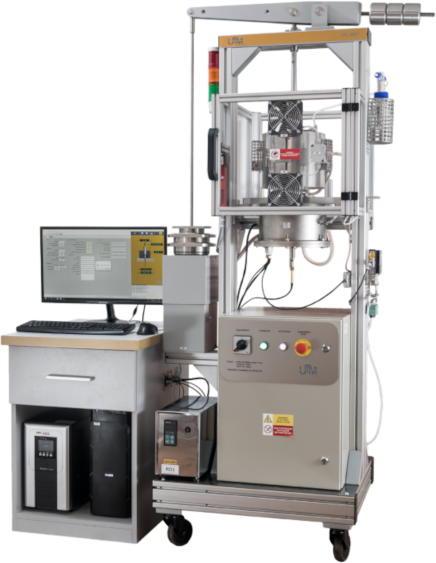
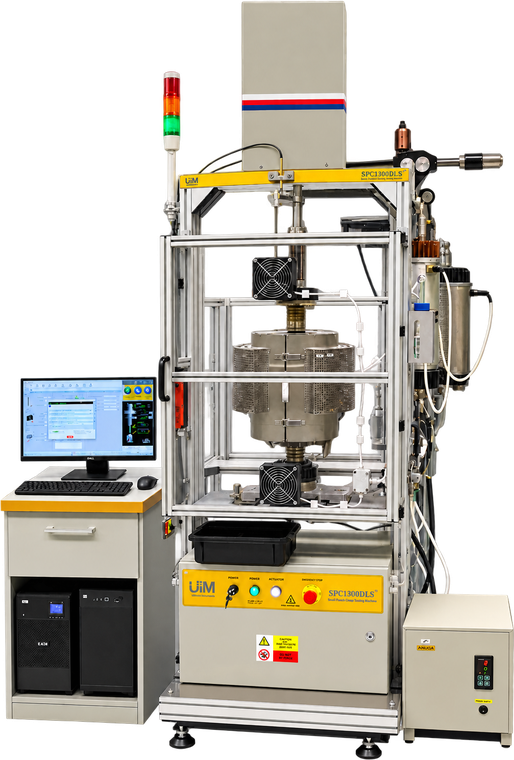
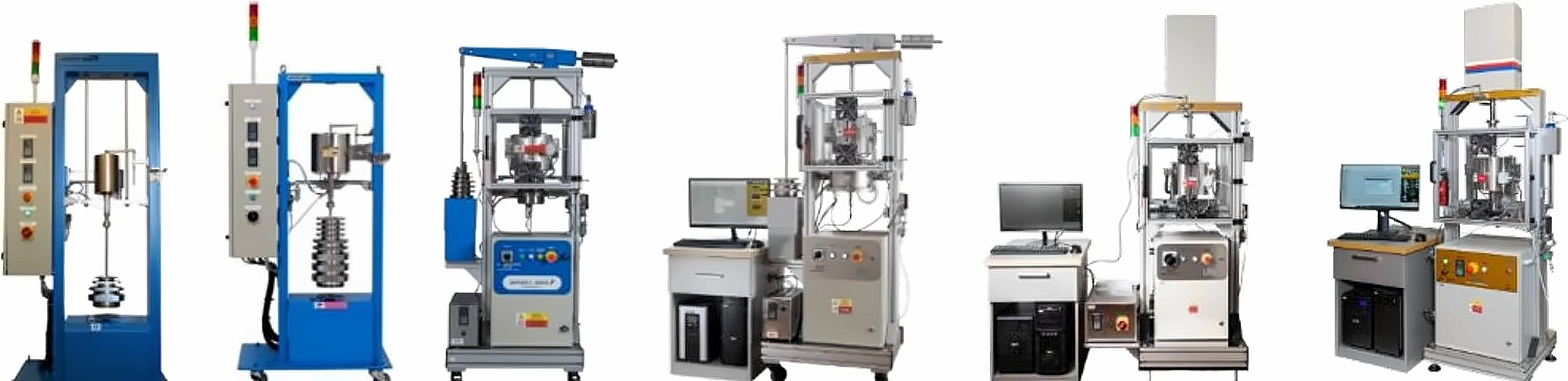
Small Punch Creep tests from room temperature up to 1200 °C in argon, and tensile and fracture tests from room temperature down to −193 °C — on Ø8 mm or Ø3 mm test pieces. Five machines, customised to your test, designed and built in the Czech Republic by a team that helped shape EN 10371.
This is the whole test piece. Ø8 × 0.5 mm, or Ø3 × 0.25 mm for Mini Small Punch, shown at about actual size. Enough for creep, strength and transition-temperature data where a standard test piece will not fit.


New to the method?
The Small Punch Test in 30 seconds
- 1A disc Ø8 mm is cut and ground to 0.5 mm (or Ø3 × 0.25 mm for Mini Small Punch). From a weld, a thin wall, irradiated material or a small sample taken from a service-exposed component.
- 2It is clamped between two dies. A punch with a Ø2.5 mm ball pushes through its centre into a Ø4 mm hole (Ø1 mm ball and Ø1.75 mm hole for Ø3 mm test pieces).
- 3The deflection is recorded. Over time under constant force for creep, or against force at a set temperature for tensile and fracture properties.
The procedure is standardised as EN 10371 “Metallic materials – Small punch test method” (2021). Our machines are built to it.

Track record
We helped shape the standard we build to
Round robin behind EN 10371
Holmström et al., “Creep strength and minimum strain rate estimation from Small Punch Creep tests”, Materials Science and Engineering A 731 (2018). D. Omacht is a co-author.
Machines and the code of practice
Omacht et al., Key Engineering Materials 734 (2017): proposals to improve the CWA 15627 procedure that EN 10371 grew out of.
Very-high-temperature SPC, ECCC 2026
Design and experimental verification of our highest temperature class to EN 10371, with the Institute of Physics of Materials, Czech Academy of Sciences.

Why results agree
What our machines are built around
Two test-piece sizes
Small Punch Ø8 × 0.5 mm and Mini Small Punch Ø3 × 0.25 mm cartridges, both geometries of EN 10371.
Customised to your test
We design and build the machines ourselves, so we can adapt them to what you need to test.
Temperature on the test piece
Measured and controlled on the test piece itself, not somewhere in the furnace or chamber.
Frictionless direct loading
Constant force held for the whole creep test, ±0.1 % F.S. Lever loading as an option.
Gas-tight argon chamber
Argon atmosphere around the test piece; chamber helium leak-tested to 1×10⁻⁹ Pa·m³·s⁻¹.
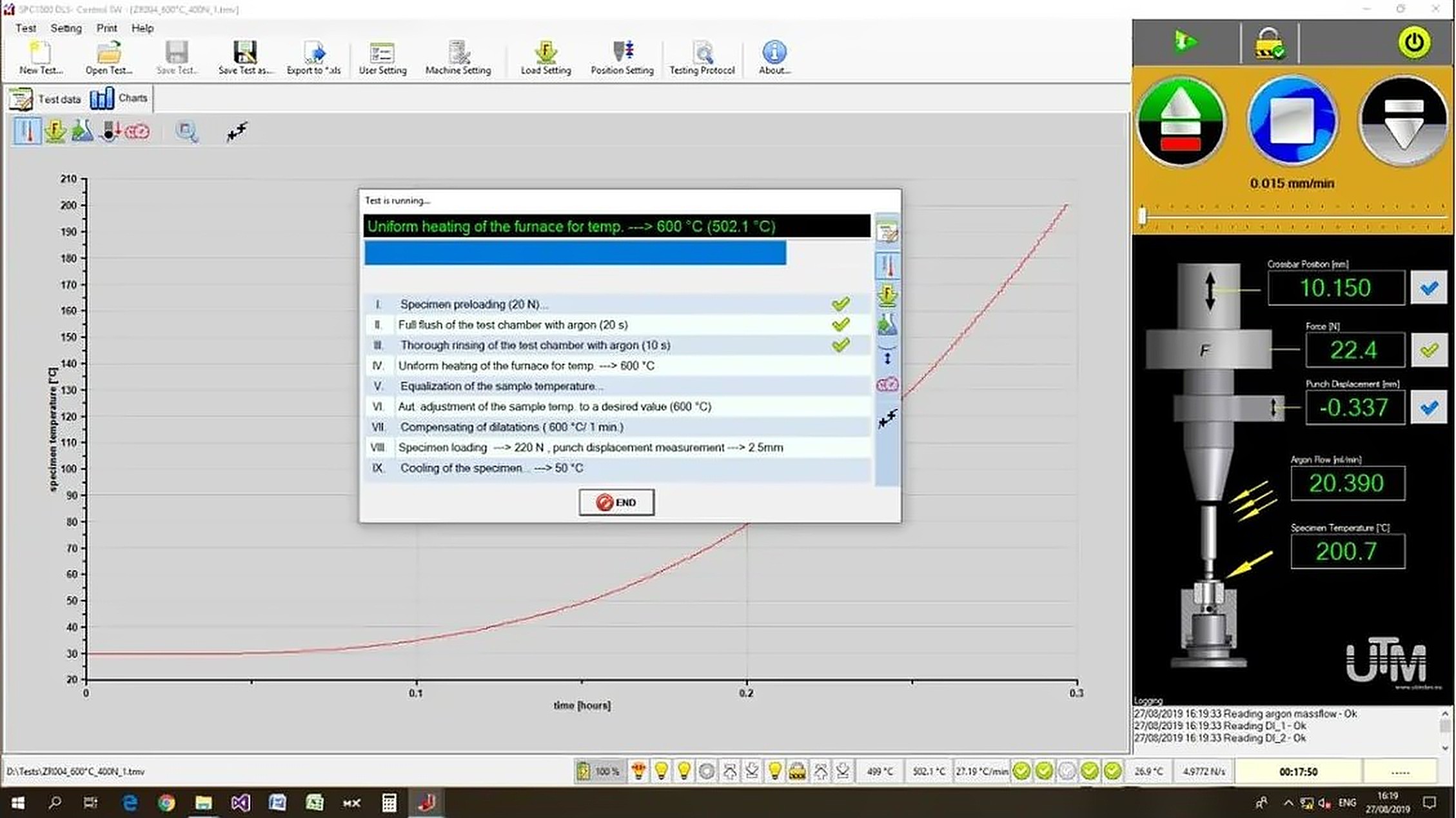
Fully automatic test run
Purge, preload, heating, loading, recording to rupture and controlled cooling. Export to XLS or the XML format developed with the JRC.
Our own software
Control software for the SPC line, SPEVAL for evaluation to EN 10371 with machine compliance correction.
Delivered ready to test
Reference test pieces for periodic checks and two days of operator training in your laboratory.
No machine yet?
Test with us first
Send us your material. We run Small Punch tests on our machines and send you a test report to EN 10371 — a good way to see the method on your own steel before you buy.
Request more information
Tell us what you need to test
Complete one sentence instead of writing an email. The more gaps you fill, the more precise our answer.
- We reply within 5 working days
- Leaflets are sent by email
- For service-exposed components we add a sampling proposal
UTMdev s. r. o., Ostrava, Czech Republic
info@utmdev.eu · +420 608 615 303