Unconventional testing machines development and realization
UTMdev s.r.o. is a Czech company based in Ostrava that develops and builds unconventional testing machines for the power industry, research institutes and universities worldwide — the USA, Germany, Italy, Finland, Poland, India and Slovakia.
At the core is the Small Punch Test method to EN 10371: from a Ø 8 × 0.5 mm test piece we determine creep properties, strength and the transition temperature. The SPC range covers temperatures up to 650, 800, 1000 and 1200 °C; the TTS 190 system covers low-temperature testing down to −193 °C. This gives the properties of the actual material of a service-exposed component — from a volume that can be removed without cutting out a block for a test piece: from the heat-affected zone of a weld, from a thin wall, from a rotor after hundreds of thousands of hours in operation.
The SCOOPER 50 takes the test material from the component itself — a shallow sample from any accessible location, so no block has to be cut out and weld-repaired afterwards; the PT 8 and GE 76 tools then produce test pieces within the tolerances of the standard. Where nothing at all is to be removed, instrumented indentation with the PIIS 3000 measures directly on the component.
We were working with the method before it had a standard: the proposals to improve the CWA 15627 procedure that EN 10371 grew out of were published by our team in 2016. We have over 20 years’ experience developing testing machines, and we write our own evaluation software.
The machine with the highest test temperature in the range, the SPC 1200, is being developed with the Institute of Physics of Materials of the Czech Academy of Sciences under the TREND programme of the Technology Agency of the Czech Republic.
Our strengths
We were working with the method before it had a standard.
We did not take up the Small Punch Test when EN 10371 appeared. Our team worked on the document the standard grew out of, and we have been building machines that meet it ever since.
We helped shape EN 10371
The proposals to improve the CWA 15627 procedure that the standard grew out of were published by our team in 2016. Since 2025 we have been on the scientific committee of the SSTT conference.
The whole chain from one supplier
Material sampling (SCOOPER 50), test-piece manufacturing (PT 8, GE 76), the SPC and TTS 190 testing machines, and our own evaluation software.
Over 20 years of building testing machines
Our machines are in use in the USA, Germany, Italy, Finland, Poland, India and Slovakia — in the power industry, at research institutes and at universities.
The evidence
Proposals to improve CWA 15627
Paper given at the 4th SSTT conference in Shanghai and published in Key Engineering Materials 734. The machines in it are the direct predecessors of today’s range.
SPTcalc — our own evaluation software
Software for evaluating the Small Punch Test to the draft standard. Today it is SPEVAL, with machine compliance correction.
EN 10371 published
The method gets its European standard. Our machines have met it from day one — same test piece, same geometry.
SPC 1200 with the Academy of Sciences
Development of the machine with the highest test temperature in the range, under the TREND programme of the Technology Agency. The project targets 1300 °C.
Indentation and neural networks
Constitutive model of austenitic steel from a network trained on FE simulations. Archives of Civil and Mechanical Engineering, with VSB Technical University of Ostrava.
Lead author in TAFM, SSTT committee
The mechatronic design and software of PIIS 3000 in Theoretical and Applied Fracture Mechanics. In Freiberg, a seat on the SSTT scientific committee and the chair of the Numerical Approaches session.
SPC 1300 in functional tests
The machine with the highest test temperature in the range is being tested. The joint project with the Institute of Physics of Materials runs to the end of the year.
Products

SCOOPER 50
Scoop sampling machine
A fully automatic, portable machine that scoops a shallow Ø 23 × 3.2 mm sample from any accessible location on a service-exposed component — pipe wall, bend or weld. No block has to be cut out and weld-repaired for the test: the scoop leaves nothing but a shallow depression, and the cut puts no heat into the component or into the sample. One sample serves for chemical and metallographic analysis and for electron microscopy, and still yields test pieces for basic mechanical properties and for special tests — resistance to brittle fracture, fracture toughness or creep (Small Punch Test, Small Punch Creep Test, Impression Creep Test and others).
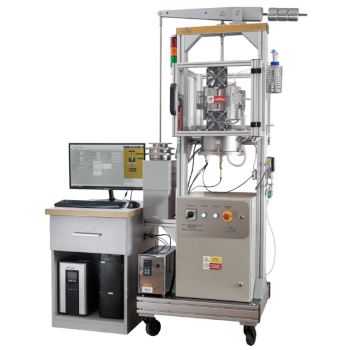
SPC 650
Small Punch Creep Testing machine for material testing in accordance with EN 10371, up to 650 °C
A fully automatic testing machine for the Small Punch Creep Test to EN 10371. In a protective argon atmosphere the test piece is held under a constant force for the whole test and its deflection is recorded against time, giving the small punch creep curve, the minimum deflection rate and the time to rupture. Maximum test temperature 650 °C; force up to 1000 N with direct frictionless loading and up to 500 N with lever loading.

SPC 800
Small Punch Creep Testing machine for material testing in accordance with EN 10371, up to 800 °C
A fully automatic testing machine for the Small Punch Creep Test to EN 10371. In a protective argon atmosphere the test piece is held under a constant force for the whole test and its deflection is recorded against time, giving the small punch creep curve, the minimum deflection rate and the time to rupture. Maximum test temperature 800 °C; force up to 1000 N with direct frictionless loading and up to 500 N with lever loading.

SPC 1000
Small Punch Creep Testing Machine for material testing in accordance with EN 10371 with direct load system
A fully automatic testing machine for the Small Punch Creep Test to EN 10371. The constant force on the test piece is applied by a direct electromechanical push system, and deflection is recorded against time, giving the small punch creep curve, the minimum deflection rate and the time to rupture. Test temperature up to 1000 °C, force up to 4000 N; the machine also runs ultra-miniature tensile and creep tests (UMTT, UMCT).
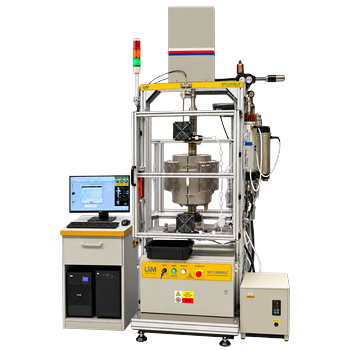
SPC 1200
High-temperature machine for creep testing of miniaturised test pieces by the Small Punch Creep Test method to EN 10371, up to 1200 °C
A high-temperature machine for the Small Punch Creep Test to EN 10371, under development for temperatures up to 1200 °C. It holds a constant force on the test piece for the whole test, up to 5000 N. It is being built in a TREND project of the Technology Agency of the Czech Republic together with the Institute of Physics of Materials of the Czech Academy of Sciences.

TTS 190
Small Punch Test system for tensile and fracture material properties determination in accordance with EN 10371
A testing system for determining the tensile properties (proof strength Rp, tensile strength Rm) and the resistance to brittle fracture (small punch energy, small punch transition temperature TSP) of metallic materials from a tiny amount of material, using the Small Punch Test to EN 10371. It tests at room temperature (23 ± 2 °C) and at low temperatures, down to −193 °C.

PIIS 3000
Non-destructive, portable Instrumented Indentation Tester
A fully automatic, non-destructive, portable tester for determining mechanical properties (yield strength, tensile strength, strain hardening exponent, Young modulus of elasticity, Brinell hardness), plane-strain fracture toughness (KIc) and weld residual stress by the instrumented indentation test (IIT) method to B0950, B0951, ISO/TR 29381, KEPIC code MDF A370 and ASME Code Case 2703. It measures directly on the component, with no material removed.

GE 76
Tool for test piece manufacturing intended for Small Punch Test or Small Punch Creep Test method
A professional tool for making test pieces (Ø8 mm, thickness 0.5 ± 0.005 mm) for the Small Punch Test or Small Punch Creep Test. The test piece is ground in four steps, exactly as EN 10371 prescribes.

PT 8
Tool for cutting out the circular shape of the sample intended for the Small Punch Test or Small Punch Creep Test
The punch and die blank a circular test piece (Ø8 mm) from flat material up to 0.8 mm thick. The test piece is then ground to its final thickness as required by the European standard EN 10371 “Metallic materials – Small punch test method”.
Services
We come to you. If we can take a sample from it or put an indent in it, we can measure it.
A way to try the method on your own material before you buy a machine.
Material sampling on site
Ø23 × 3.2 mm sample · any accessible location · 10–90 min
On-component measurement
yield and tensile strength, fracture toughness · non-destructive
Test-piece manufacturing
Ø8 × 0.5 mm · ±0.005 mm · EN 10371
Testing on our machines
Small Punch Creep Test or low-temperature testing · test report to the standard
News
Published: mechatronics design and evaluation software of a portable indentation system
The mechatronic design and the evaluation-software architecture of a portable instrumented indentation device — the principles our PIIS 3000 is built on. Lead author Daniel Omacht.
Published: instrumented indentation and neural networks for determining a material constitutive model
Instrumented indentation combined with neural networks gives the constitutive model parameters of SS304L austenitic steel directly on service-exposed components — exactly the measurement our PIIS 3000 makes. Co-author Daniel Omacht.
Published: a new instrumented spherical indentation methodology for fracture toughness determination
A new method for determining the fracture toughness of high-strength steels. We cover both routes to that value: non-destructively on the component (PIIS 3000), or from the small amount of material taken by the SCOOPER 50.
Proposal of EN 10371 was approved
CEN approved the draft of the new European test standard EN 10371 “Metallic materials – Small punch test method”. It was published in 2021, and in December 2021 as the Czech ČSN EN 10371.
New version of SPTcalc™ – software for Small Punch Test results evaluation
The new version of SPTcalc™ evaluates the proof strength Rp, the tensile strength Rm and the small punch energy to EN 10371 — including data import and a drag-and-drop correction of the Fm point.
References


Headquarters
UTMdev s. r. o.
Vystavni 198/134
703 00 Ostrava-Vitkovice
Czech Republic
+420 608 615 303
ID: 089 99 228
VAT: CZ 089 99 228
Dealership - INDIA
Plot No 89, Door No 5/49
Vanavil Flats - A2 Natesan Nagar
Ramapuram, Chennai - 600089, India
+914 422 490 691